What makes the swing so large here
The daily temperature range — meteorologists call it the diurnal range — is not the same everywhere in Texas. Houston rarely swings 20°F in a day. Bulverde, Boerne, and the country north of San Antonio routinely swing 35 to 40°F, and the reasons are geographic and specific.
Low humidity. Water vapor is the dominant greenhouse gas in the lower atmosphere. Humid air absorbs outgoing infrared radiation and re-emits it downward, which is why the Gulf Coast stays warm at night. Hill Country air is drier, so nighttime heat escapes to space largely unimpeded.
Elevation and the escarpment. Bulverde sits several hundred feet above San Antonio on the Balcones Escarpment. Higher, drier air cools faster after sunset, and the terrain lets cooled air drain downhill into valleys and low spots — which is why properties in a draw can read several degrees colder at dawn than a ridge a mile away.
Thin soil over limestone. Deep soil is a thermal battery; it absorbs heat during the day and releases it slowly at night. The Hill Country has a thin mantle of soil over rock, so there is comparatively little mass to buffer the swing. Exposed limestone heats fast and sheds that heat fast.
Clear skies. Cloud cover acts as a blanket. On the clear nights that dominate the Hill Country calendar, radiational cooling runs at full efficiency.
What your roof actually experiences in a day
Air temperature understates the story considerably, because your roof is not measuring air. A dark, sun-facing roof surface runs 40 to 60°F hotter than the surrounding air at midday.
So on a routine July day in Bulverde — 99°F afternoon high, 68°F before dawn, a 31°F air swing — the roof surface itself reaches roughly 155 to 165°F and drops to near 65°F overnight. That is a 90 to 100°F swing at the material, every day, for months.
An unvented or poorly vented attic beneath that reaches 130 to 150°F, which loads the underside of the deck as well as the top. And the west-facing slope gets the worst of it — peak sun in the hottest part of the afternoon — which is why premature failure is so often visible on one plane of a roof while another looks serviceable.
| Surface | Peak summer temp | Overnight | Daily excursion |
|---|---|---|---|
| Air temperature | ~99°F | ~68°F | ~31°F |
| Dark asphalt shingle surface | 155–165°F | ~65°F | 90–100°F |
| Unvented attic air | 130–150°F | ~72°F | 60–78°F |
| Reflective metal over ventilated deck | ~115–130°F | ~65°F | 50–65°F |
| Roof deck under a vented assembly | ~110–125°F | ~68°F | 42–57°F |
Thermal cycling fatigue, mechanism by mechanism
Repeated expansion and contraction is a fatigue load, and fatigue accumulates. Nothing dramatic happens on any given day; the roof simply uses up cycles. Here is where they get spent.
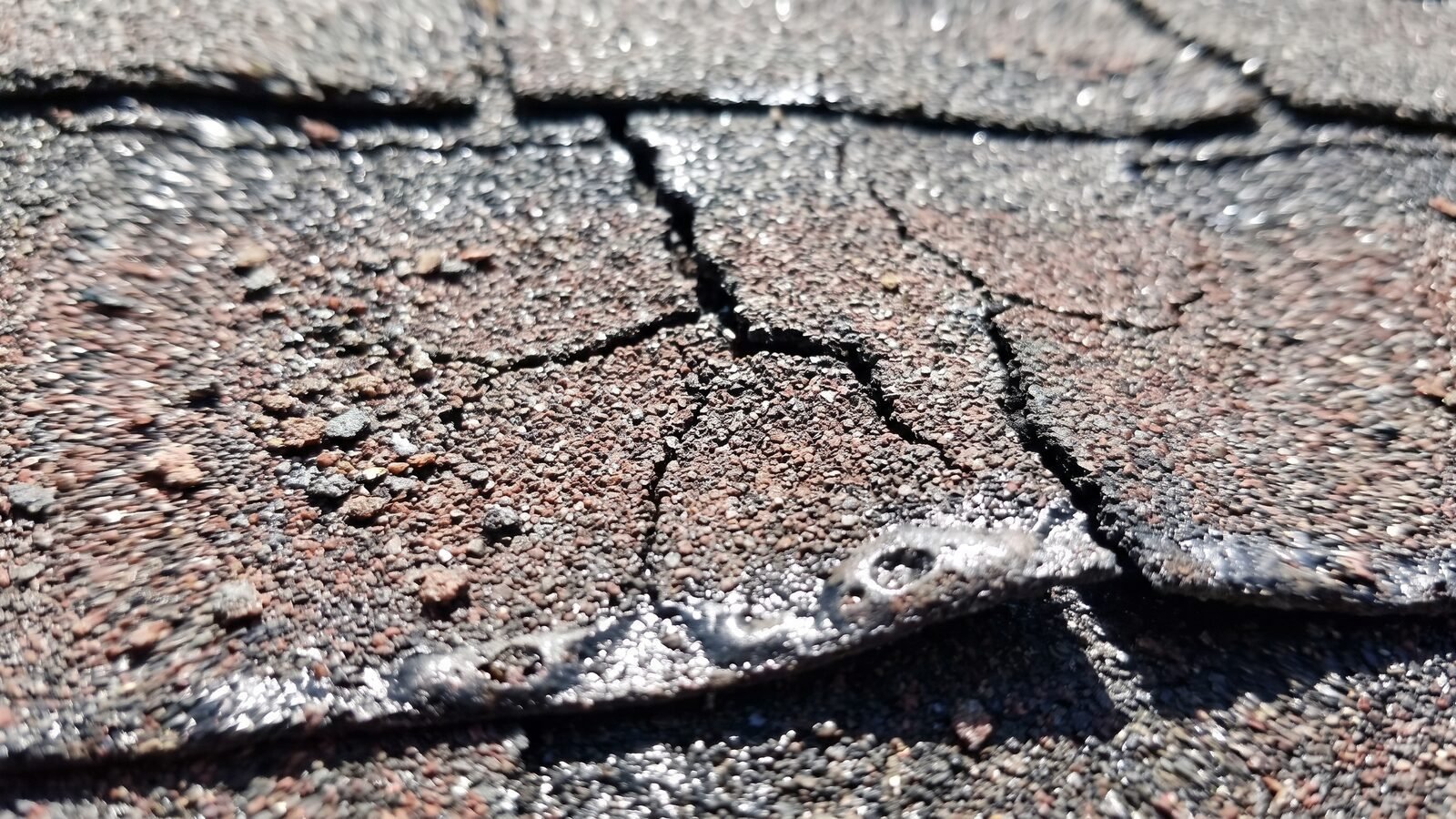
Asphalt volatilization. Shingles are a fiberglass mat saturated in asphalt, and asphalt is a petroleum product containing volatile oils that keep it flexible. Sustained high temperature drives those oils off. The mat gets progressively more brittle, and a brittle shingle cannot absorb the movement it is being asked to absorb.
Granule loss. The mineral granules on a shingle are the UV shield for the asphalt underneath. As the substrate hardens and cycles, granules loosen and wash into the gutters. Finding granule accumulation in your gutters is a real aging signal, not debris.
Fastener movement. Each shingle expands and contracts against nails that do not move. Over thousands of cycles the nail hole works slightly larger, and nails can back out — "nail pops" that lift the shingle above and create a leak path.
Sealant strip fatigue. Architectural shingles rely on a factory adhesive strip that bonds each course to the one below, and that bond is what resists wind uplift. Repeated hot-cold cycling fatigues it. This is why an older roof loses shingles in a wind event that a newer roof of the same product shrugs off.
Flashing and penetration joints. Different materials expand at different rates. Metal flashing against wood decking against asphalt shingle, cycling 90°F daily, is a joint being worked open in slow motion. Which is exactly why valleys, pipe boots, and roof-to-wall junctions are where roofs in this region actually leak.
Deck movement. Plywood and OSB expand and contract too. Panel edges can telegraph through as visible ridging, and repeated movement loosens the nailing pattern.
Why the printed warranty and the real lifespan diverge
A shingle wrapper says 30 years, sometimes 50, sometimes "lifetime." In the Hill Country, plan on 20 to 25 years for a quality architectural shingle, and less than that for an entry-grade product on a poorly ventilated attic.
This is not a defect and manufacturers are not being dishonest. Those durations come from standardized accelerated testing that cannot fully reproduce the specific combination of UV intensity, sustained heat, and daily thermal excursion this region delivers. Warranties are also typically prorated and cover material defects — not the ordinary aging that heat cycling causes.
The honest way to read a warranty is as a statement about manufacturing consistency, not a service-life prediction for your address. Ask instead what drives the spread between 15 years and 25 on the same product, and the answer is mostly ventilation, installation quality at the penetrations, and how dark the roof is.
Ventilation is the biggest lever you control
You cannot change the climate, the sun angle, or the fact that asphalt loses oils when it is hot. You can substantially change how hot the assembly gets, and ventilation is the highest-leverage variable available.
Balanced intake and exhaust. A ventilated roof needs low intake at the soffit and high exhaust at the ridge, sized to attic volume, so air actually moves. This is the part most commonly done wrong: a ridge vent installed with no soffit intake, or insulation stuffed into the eave blocking the intake baffles, produces a roof that looks vented and is not. Exhaust without intake does almost nothing.
Do not mix exhaust types. A ridge vent combined with powered fans or gable vents can short-circuit — the fan pulls air from the nearest opening rather than drawing it up from the soffits, so the far end of the attic stays stagnant.
Insulation at the ceiling plane, not the roof plane, in a vented assembly, and keep it out of the eave baffles. A properly vented and insulated attic runs dramatically cooler than an unvented one, which slows every fatigue mechanism above and reduces your cooling load at the same time.
If you want to eliminate the variable rather than manage it, a reflective standing seam roof over a ventilated deck cuts peak attic temperature by up to 40°F relative to dark asphalt — that is the same system logic, applied at the surface as well as the cavity.
Material choices that tolerate movement
Given a climate that cycles hard every day, some assemblies are simply better suited than others.
Standing seam metal is designed around thermal movement rather than resisting it. Concealed clips let each panel slide as it expands and contracts, so the movement is absorbed by the assembly rather than by fastener holes. There is no organic binder to volatilize and no granules to lose. Reflective PVDF finishes reduce peak temperature substantially. This is the reason a metal roof reaches 40 to 70 years here while asphalt reaches 20 to 25.
Class 4 impact-resistant asphalt remains a sound choice, and it is what we specify when asphalt is the right answer. The polymer-modified mats used to achieve UL 2218 Class 4 are more flexible than standard asphalt, which means they tolerate both hail impact and thermal movement better. Paired with synthetic underlayment and correct ventilation, it is a well-matched system for this region.
Tile handles heat well — the barrel profile creates its own ventilated air space above the deck. Remember, though, that the underlayment beneath it is the waterproofing and has a 20-to-30-year life, so the assembly is not as permanent as the tile is.
Exposed-fastener metal panels are where thermal movement becomes a liability rather than an asset. Every screw penetrates the panel through a neoprene washer, and the panel moves against that screw every day. The washers are a maintenance item, and on a residential roof in this climate an exposed-fastener panel will need fastener service long before a standing seam roof needs anything.
What to inspect, and when
Twice a year from the ground with binoculars, plus after any significant storm. You are looking for the signatures of accumulated cycling, and a roof that shows several of these at once is telling you where it is in its life.
Signs of thermal fatigue, roughly in the order they appear:
- Granules in the gutters and at downspout outlets — the most reliable early aging indicator
- Shiny or dark patches on the shingle field — granule loss exposing asphalt, which then ages faster
- Curling or cupping at shingle edges and corners — the mat has lost flexibility
- Cracking that follows no impact pattern — fatigue, not hail; hail damage is random and localized
- Shingle tabs lifting or nail heads visible above the surface — sealant strip and fastener movement
- Sealant cracked or pulled at pipe boots and flashing — the joints being worked open
- Visible ridging that follows the deck panel lines — deck movement telegraphing through
- One slope, usually west-facing, aged noticeably ahead of the others — normal and diagnostic
Frequently asked
Why does Bulverde get so much colder at night than San Antonio?
Elevation, dry air, thin soil, and clear skies. Bulverde sits several hundred feet higher on the Balcones Escarpment, and dry air with little soil mass to buffer it radiates heat to space efficiently after sunset. San Antonio also carries an urban heat island effect that holds warmth overnight. Cooled air draining into valleys can make low spots several degrees colder still.
How hot does a roof surface actually get here?
A dark asphalt roof in direct summer sun reaches roughly 155–165°F — 40 to 60°F above the air temperature — and falls to near the overnight low. That is a 90 to 100°F daily excursion at the material, every day for months.
Can a roof fail from heat alone, with no hail?
Yes, and it is common here. Volatile oils leave the asphalt, granules shed, sealant strips fatigue, and fasteners work loose from thousands of expansion cycles. Insurance treats that as ordinary wear rather than a covered loss, which is exactly why it catches people by surprise.
My shingles are warranted for 30 years. Why would they only last 20?
Warranty durations come from standardized accelerated testing and cover material defects on a prorated basis — they are not service-life predictions for a specific climate. Sustained UV, high heat, and a 90°F daily surface excursion age asphalt faster than the test conditions represent. Ventilation quality is the biggest factor in where you land in the range.
Does more attic ventilation actually help, or is that a sales line?
It genuinely helps, but only if it is balanced. Exhaust at the ridge without adequate soffit intake does very little, and mixing a ridge vent with powered fans or gable vents can short-circuit airflow so the far end of the attic stays stagnant. Correctly balanced intake and exhaust lowers peak attic temperature substantially, which slows every heat-driven failure mode and cuts cooling load.
Is metal worth it just for the thermal issue?
For a lot of Hill Country homes, yes. Standing seam is engineered to move — concealed clips let panels slide with expansion instead of grinding against fasteners — and it has no organic binder to lose or granules to shed. That is the mechanical reason for a 40-to-70-year service life against 20-to-25 for asphalt in the same conditions.
This guide is general regional information for Hill Country property owners, not engineering, medical, legal, or insurance advice for your specific property. Figures cited reflect commonly published agency, manufacturer, and industry sources and vary by site. For foundation movement consult a licensed professional engineer; for water quality use an accredited laboratory; for wildfire mitigation see Texas A&M Forest Service guidance and your local fire authority.