The ember, not the flame front
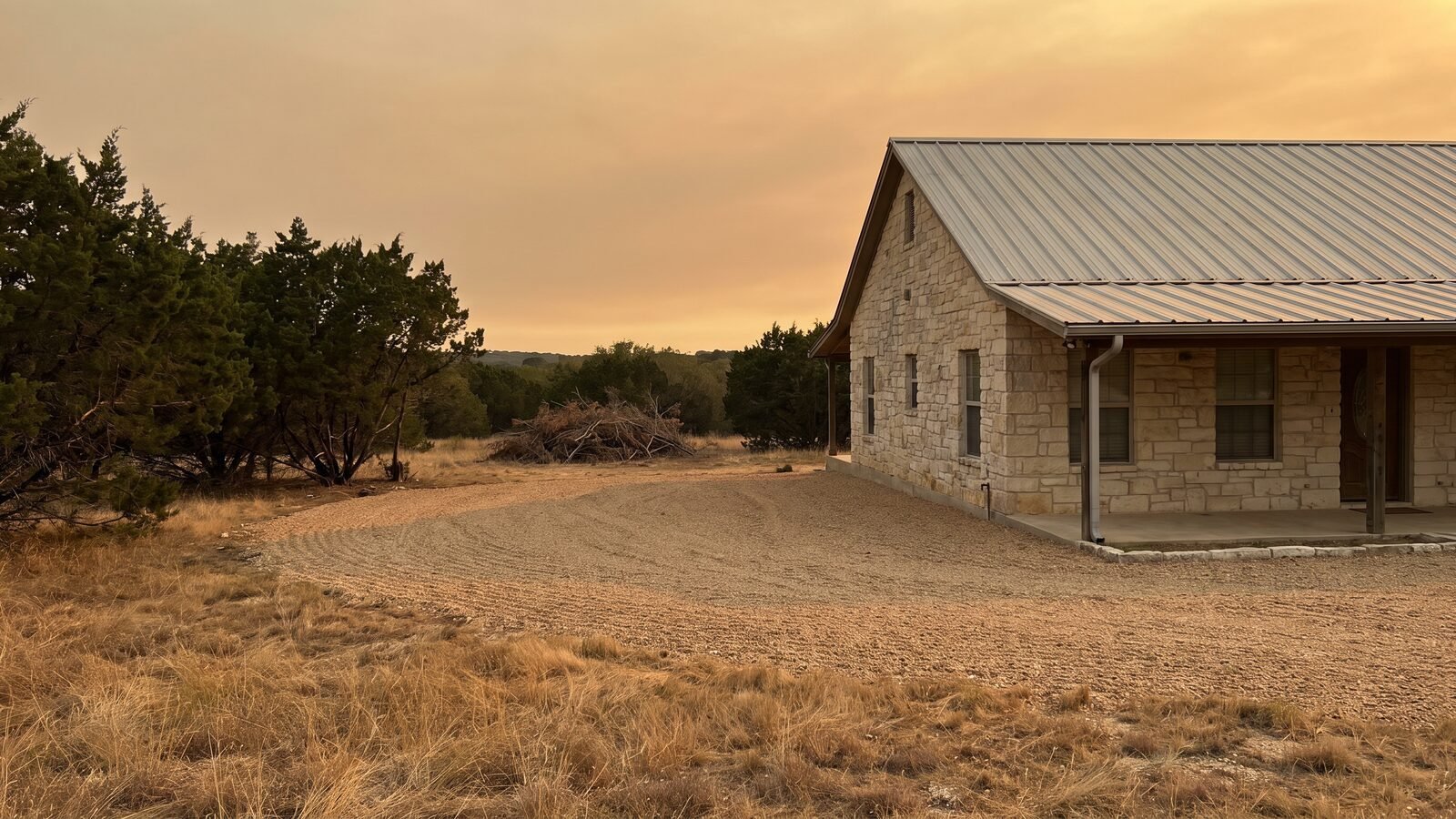
Most of the developed Hill Country is what fire agencies call wildland-urban interface — houses set into cedar, oak, and native grass, often on narrow county roads with a single way out. Hays County has burned before, and the fuel load after a wet spring followed by a hot dry summer is genuinely high.
The mental image most people carry is wrong in a useful way. Post-fire investigations of interface losses consistently find that houses ignite from embers — firebrands lofted by wind, traveling well ahead of the fire, sometimes more than a mile. They arrive as a shower of glowing material that lands on and around the structure, finds something receptive, and smolders. Many structures ignite hours after the front has passed, from the inside or the underside.
This changes the priority order entirely. Clearing brush is worthwhile, but a house with an immaculate 100-foot clearing and unscreened attic vents is more vulnerable than a house with modest clearing, screened vents, and nothing combustible touching the walls. Fix the ember traps first.
Zone 0: the first five feet
The five feet immediately around your foundation is the highest-consequence square footage on your property. An ember landing there ignites something that is in direct contact with your wall.
Everything in that band should be noncombustible: gravel, decomposed granite, bare mineral soil, or stone. That specifically means no bark or shredded mulch, which is one of the most effective ember-catching materials available and is exactly what most landscape plans put against the house.
Then look at what people actually store there, because this is where the real risk lives: firewood stacked against the siding, the propane tank, a plastic garbage bin, patio cushions, a doormat, the woven synthetic rug on the porch, the wooden trellis with jasmine on it. Any of these will carry a smoldering ember into sustained flame right at your wall.
Also in Zone 0 and routinely missed:
- Under decks and porches — enclose or screen with 1/8-inch metal mesh, and keep the space swept clear
- The gap between a wood fence and the house — a wood fence attached to the wall is a fuse leading to it
- Dead leaves and cedar litter in the corner where a bay window meets the wall
- Anything stored under an exterior stair
Vents: the highest-value fix on the list
A standard soffit, gable, or ridge vent is an opening designed to move air freely. It moves embers just as freely, straight into an attic full of the most combustible material in your house: paper-faced insulation, stored boxes, and dry framing. An attic fire that starts from an ember typically has a long head start before anyone sees smoke.
The fix is corrosion-resistant metal mesh with openings of 1/8 inch or finer over every vent opening. Metal specifically — fiberglass or plastic insect screen melts. Not window screen with larger openings, which passes small firebrands. And every opening, including the ones people forget: crawlspace vents, dryer vent, the foundation vents on a pier-and-beam house, and any gable vent behind a decorative louvre.
Do not simply block the vents. Your attic ventilation is doing necessary work — in this climate it is a major factor in roof lifespan and in summer cooling load. Screen the openings; do not eliminate them.
Roof and eave assemblies
Your roof is the largest ember-collection surface you own, and its job during an ember shower is to give firebrands nowhere to rest and nothing to catch.
Class A fire-rated roof covering is the baseline: asphalt shingle, metal, clay or concrete tile all achieve it as installed assemblies. Standing seam metal performs particularly well here, because it presents an unbroken noncombustible surface with no gaps between courses where embers can lodge.
The details, however, are where roofs actually fail in interface fires. Debris in the gutters is a horizontal trough of dry cedar litter running along the edge of your roof — clean it, and consider a noncombustible metal micro-mesh guard. Open eaves expose the underside of the deck and the rafter tails to direct ember contact; a boxed-in, fire-resistant soffit removes that exposure. Tile roofs need their open ends birdstopped so embers cannot blow up under the barrels. And at every roof-to-wall junction, the accumulated litter in that corner should be cleared as routine maintenance.
Zones 1 through 3: defensible space
Beyond the first five feet, the goal shifts from ember resistance to reducing fire intensity and giving firefighters somewhere safe to work. Texas A&M Forest Service publishes the authoritative regional guidance; what follows is the practical shape of it.
Zone 1, 5 to 30 feet. Well-irrigated and heavily thinned. Break up continuous fuel so there is no unbroken path of vegetation to the house. Remove ladder fuels — the low branches and shrubs that let a grass fire climb into a tree canopy. Prune tree limbs to 6 to 10 feet above the ground, and keep all limbs at least 10 feet from the roof and the chimney.
Zone 2, 30 to 100 feet. Thin, do not clear. Space tree crowns roughly 10 feet apart so fire cannot run canopy to canopy. This is where Ashe juniper matters most: cedar carries volatile oils, burns hot and fast, and grows in dense thickets. Thinning cedar is the single highest-value vegetation work on most Hill Country lots.
Zone 3, 100 feet and beyond. Reduce heavy accumulation, remove dead standing timber, and keep it grazed or mowed where you can. On a large property this is a multi-season project, and it is genuinely worth doing in the order given here rather than starting at the fence line.
Water when the power is out
This is the rural detail that surprises people, and it deserves emphasis. If you are on a private well and the grid goes down, you have no water. Your pump is electric. Wildfire and power loss arrive together routinely — utilities de-energize lines in high-wind fire conditions, and fire takes lines down.
So the plan cannot be "wet down the house as it approaches." Practical options: a generator sized to run the well pump, with the transfer arrangement tested before fire season and fuel actually on hand; gravity-fed storage, which is why cisterns and stock tanks are a genuine asset here; or a portable pump that can draw from a pool or tank independently of the grid.
Also note that if you have a rainwater catchment system, firefighters may be able to draft from it — but only if they can reach it and connect. Clear access to the tank matters.
Evacuation readiness for a one-road property
Many properties out here have exactly one way to the highway, sometimes a caliche road with a single-lane low-water crossing. That is a fixed constraint, so the response is to leave earlier than feels necessary.
Sign up for your county's emergency notification system now rather than during an event, and do not rely on it as the only trigger. Keep a go-bag with medication, documents, and pet supplies staged during fire season. Know a second route out even if it is worse. Note that horses and livestock take substantially longer to move than you expect, and plan for that time explicitly.
If you are leaving and have a minute: close every window and interior door, leave exterior doors unlocked for firefighters, shut off the gas at the tank, move patio furniture and cushions inside, and leave your outdoor lights on so the structure is visible in smoke.
A season-by-season checklist
Nothing on this list requires a contractor except where noted, and the whole list is achievable across a year of ordinary weekends.
| When | Task | Why now |
|---|---|---|
| Late winter | Thin cedar and remove ladder fuels | Cooler work, and before nesting season restrictions |
| Early spring | Screen every vent with 1/8" metal mesh | Before the dry season; highest-value single fix |
| Early spring | Clear Zone 0 — mulch, firewood, stored items off the wall | Removes the direct-contact ignition path |
| Spring | Clean gutters and roof-to-wall junctions | Cedar litter accumulates all winter |
| Spring | Test generator or backup water; confirm fuel | Before you need it with the grid down |
| Early summer | Prune limbs 10 ft off the roof and chimney | Growth flush is done, before peak fire weather |
| Peak season | Re-clean gutters; keep Zone 0 swept | Debris returns fast in wind |
| Any time | Enclose or screen under decks and porches | Common ember trap, easy to forget |
Frequently asked
What size mesh should I use on attic and soffit vents?
1/8-inch or finer openings, in corrosion-resistant metal. Fiberglass and plastic insect screening melt, and standard window screen passes small firebrands. Cover every opening including crawlspace and gable vents — but screen them rather than blocking them, because attic ventilation is doing important work in this climate.
Do I have to remove all the cedar on my property?
No, and clear-cutting is not the recommendation. Thin it — break up the dense continuous thickets, space remaining crowns roughly 10 feet apart, and remove the ladder fuels underneath that let a grass fire climb into the canopy. Cedar burns hot and fast, so reducing continuity matters more than reducing total count.
Is a metal roof better for wildfire than shingles?
Both achieve Class A as installed assemblies, so the covering rating is comparable. Standing seam metal has a practical edge because it presents an unbroken noncombustible surface with no course gaps for embers to lodge in. The larger difference is in the details either way: eaves, vents, gutter debris, and roof-to-wall junctions.
What is the cheapest meaningful thing I can do this weekend?
Two things: screen your vents with 1/8-inch metal mesh, and clear the first five feet around the house of mulch, firewood, and stored combustibles. Together they cost very little and address the dominant ignition path in interface fires.
Will my homeowners insurance require any of this?
Increasingly, yes. Carriers writing in Texas wildfire-exposed areas have tightened underwriting, and some now require defensible space or specific roof ratings as a condition of renewal. Documenting the mitigation work you have done — with dated photos — is worth having when you renew.
This guide is general regional information for Hill Country property owners, not engineering, medical, legal, or insurance advice for your specific property. Figures cited reflect commonly published agency, manufacturer, and industry sources and vary by site. For foundation movement consult a licensed professional engineer; for water quality use an accredited laboratory; for wildfire mitigation see Texas A&M Forest Service guidance and your local fire authority.