Home Systems
Gutters are foundation equipment on expansive clay.
Hill Country soil swings between rock-hard and saturated, and it changes volume when it does. Roof water dumped at the foundation line is the most common cause of slab movement we see — and the cheapest to fix. On catchment properties, the same system is your drinking water.
600Gallons per 1,000 sq ft, per inch
10 ftMinimum discharge from foundation
6"Seamless K-style standard
0.032"Aluminum thickness
Why do gutters matter so much for Hill Country foundations?
Because one inch of rain on a 1,000 sq ft roof is about 600 gallons, and without gutters it lands in a concentrated trench along your foundation. The clay soils layered over Hill Country limestone are expansive — they swell when saturated and shrink when they dry. Repeated cycles of soaking one edge of a slab while the other side stays dry cause differential movement, and that is what cracks slabs and racks door frames. Gutters that discharge at least 10 feet away keep the moisture around the foundation uniform, which is the actual goal.
The discharge point matters more than the gutter
A correctly hung gutter that empties two feet from the wall has moved the problem, not solved it. The water still saturates the soil inside the zone that supports your foundation.
We extend downspouts a minimum of 10 feet from the foundation, and where grade fights us we run buried solid PVC to a daylight point or a dry well. On lots that slope toward the house — common on hillside builds around Boerne and Spring Branch — that sometimes means a French drain or a swale in addition to gutters. We would rather tell you that than sell you gutters that cannot work on your grade.
The pairing with the foundation watering guide is deliberate: gutters control where water leaves, foundation watering controls the minimum moisture the soil keeps during drought. Both exist to hold the soil at a stable volume year-round.
Catchment systems: this is drinking water
Many properties around Dripping Springs, Wimberley, and Blanco collect roof runoff into cisterns for potable or irrigation use. Those systems have requirements a standard gutter job ignores.
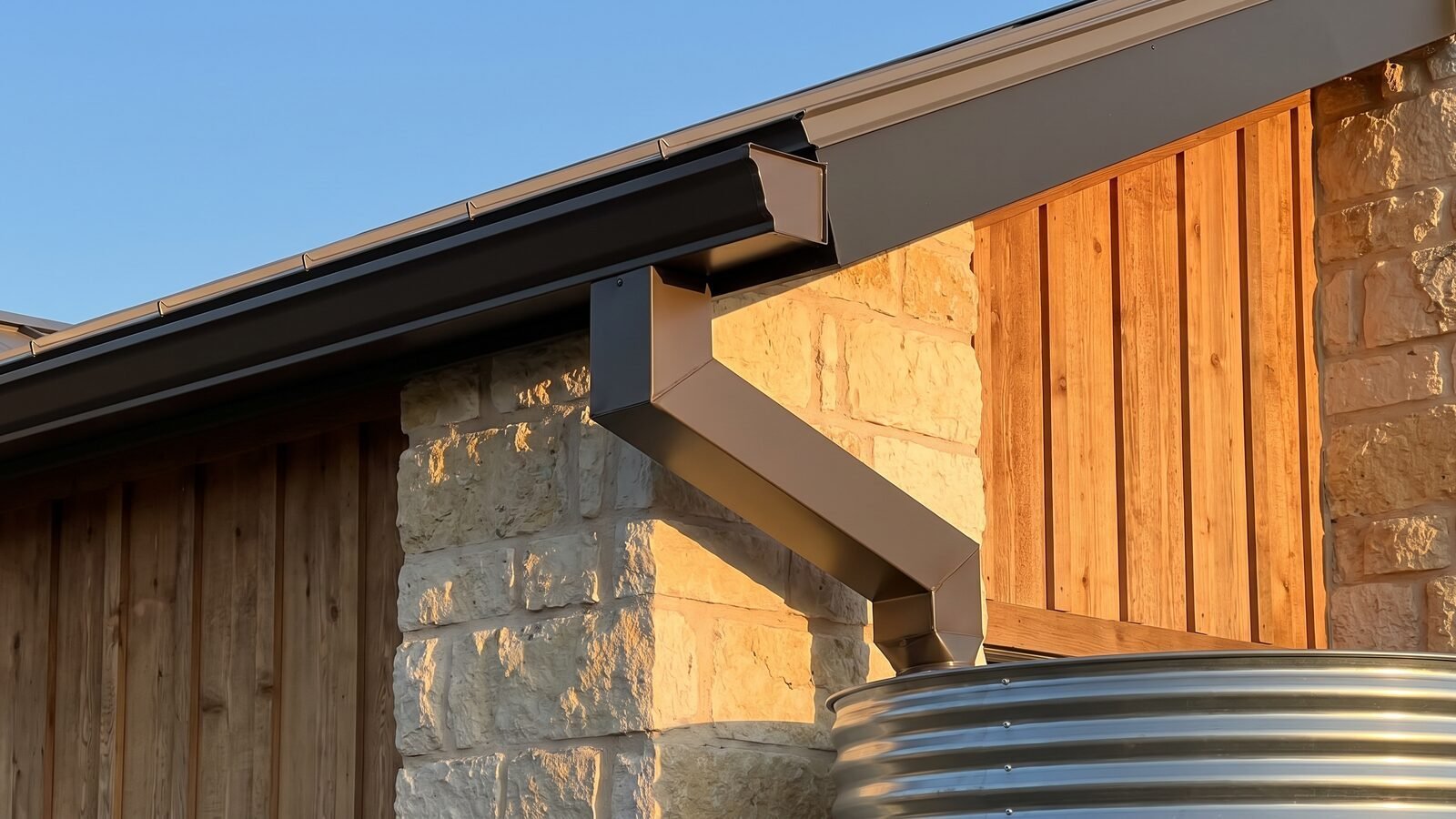
A first-flush diverter discards the initial dirty volume off the roof. Debris screening keeps organics out of the tank. Roof and gutter materials must be inert — no lead flashing, no tar-based patching, no galvanized-to-copper contact in the water path. Overflow has to be routed away from the foundation, not into it, which is exactly where poorly designed catchment overflows end up.
If you are on catchment or plan to be, say so at the quote stage. It changes the alloy, the flashing, and the layout.
Specification
| Item | What we install |
|---|---|
| Gutter | 6" seamless K-style or half-round, 0.032" aluminum |
| Fastening | Hidden hangers screwed into rafter tails, 24" on center |
| Downspouts | 3"x4" oversized for Hill Country downpour intensity |
| Discharge | Minimum 10 ft from foundation; buried to daylight where grade requires |
| Guards | Micro-mesh where oak and cedar debris load is heavy |
| Catchment | First-flush diverter, screening, inert materials, overflow routed away |
Talk about your gutters & rainwater project
Tell us the property and the scope. We start with site and systems discovery, not a sales pitch.
Bid comparison
Where the cheap bid is actually cheaper.
Two proposals for the same job usually differ on these lines, not on brand. Ask any bidder to put their answer in writing.
| Common low-bid approach | The A1 specification |
|---|---|
| Downspout dumping at the wall | Extended 10+ ft or buried to daylight |
| Spike-and-ferrule hangers | Hidden hangers screwed to rafter tails |
| 5" gutter, 2x3 downspouts | 6" seamless with 3x4 oversized downspouts |
| Catchment treated as a normal gutter job | Diverter, screening, inert material path |
Gutters & Rainwater questions
Answered plainly.
How far should downspouts discharge from the house?
At least 10 feet, farther if the grade slopes back toward the house. On expansive clay, a downspout emptying at the foundation defeats the entire purpose of having gutters — you have concentrated the water instead of dispersing it.
Are gutter guards worth it under oak and cedar?
Micro-mesh is, under heavy tree load. Foam inserts and screen mesh clog with cedar debris and oak catkins and turn into a wet mat that holds water in the trough. Bare gutters under mature oaks need cleaning at least twice a year.
Can I drink water off my metal roof?
Off an appropriate roof, with the right system. Galvalume or PVDF-finished metal is the standard catchment surface. You need a first-flush diverter, screening, inert materials throughout the water path, and appropriate filtration and disinfection at the point of use. Avoid lead flashing, tar patches, and mixed-metal galvanic pairs.
Also in Home Systems
Related scopes.